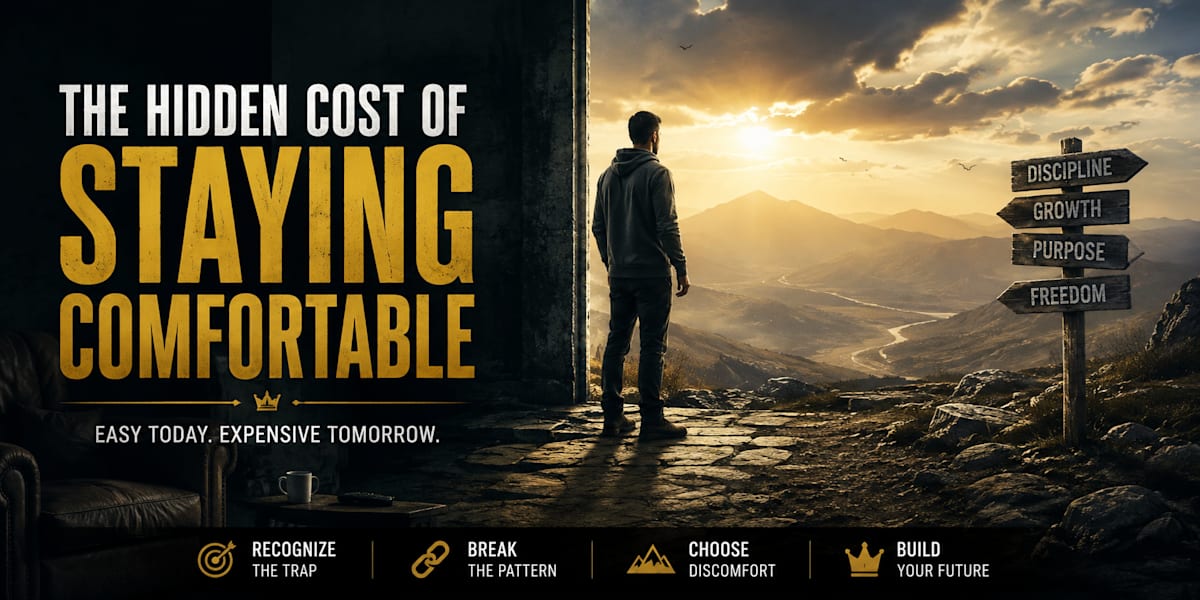
Comfort feels good. That is precisely what makes it dangerous. Most of us are taught to recognize the obvious threats to our future: failure, bad decisions, financial problems, unhealthy relationships, and missed opportunities. We understand that these things can derail our lives. But some of the greatest obstacles we face do not look like obstacles at all. Sometimes they look like a comfortable chair after a long day. Sometimes they sound like, “I’ll start tomorrow.” Sometimes they appear as a job we have outgrown, a dream we have stopped pursuing, a conversation we keep avoiding, or a routine that no longer challenges us. Nothing may seem terribly wrong, and that is often the problem.
There is nothing wrong with comfort itself. We need rest. We need moments when we are not fighting, building, competing, producing, or pushing ourselves forward. A healthy life cannot consist of constant struggle. But there is an enormous difference between using comfort to recover and using comfort to avoid growth. Rest prepares you to move again. The comfortable trap convinces you that you do not need to move at all. That is when comfort becomes expensive.
The cost rarely arrives immediately. There is no alarm telling you that you have become too comfortable. There is no notification informing you that you have postponed your goals for another year. Instead, the consequences accumulate quietly. One skipped workout does not destroy your health. One unnecessary purchase does not destroy your finances. One evening spent procrastinating does not destroy your career. One abandoned goal does not destroy your future. But repeated often enough, small choices become patterns, patterns become habits, and habits eventually become lives.
We naturally prefer immediate rewards. The couch feels better than the workout. Spending feels better than saving. Sleeping another hour feels better than getting up early. Avoiding the difficult conversation feels better than confronting the problem. Watching another episode feels better than working on the business, degree, project, book, or dream. In the moment, the comfortable option often wins. The problem is that easy choices frequently provide immediate relief while transferring their consequences to your future self. You do not eliminate the difficulty. You postpone it, and postponed difficulty often becomes greater difficulty.
The workout you continually avoid can become the health problem you eventually have to confront. The money you do not save can become the financial pressure you later experience. The skill you refuse to learn can become the opportunity you are not qualified to take. The dream you continually postpone can eventually become one of the most painful questions a person can ask: What would have happened if I had actually tried?
One of the most dangerous words in the English language is “someday.” Someday I will write the book. Someday I will start exercising. Someday I will apply for that position. Someday I will start the business. Someday I will repair that relationship. Someday I will learn that skill. Someday I will finally take myself seriously. The problem is that someday does not exist on a calendar. Monday does. August does. 2026 does. Today does. Someday does not.
When we tell ourselves that we will do something someday, we receive the emotional comfort of believing we have not abandoned the goal while avoiding the discomfort required to pursue it. That is what makes procrastination so deceptive. You have not necessarily said no to the dream. You have simply said “not yet” over and over again. Eventually, enough versions of “not yet” produce the same result as no.
So how do you know when comfort has become a trap? Ask yourself a difficult question: Is my current life comfortable because I have built something I am genuinely satisfied with, or because I have stopped asking more from myself? Those are very different situations.
There are warning signs. You continually talk about things you are going to do but rarely begin them. You know something in your life needs to change, but the inconvenience of changing it feels worse than remaining dissatisfied. You make the same promises to yourself every month or every year. You avoid opportunities because failure would be uncomfortable. You choose predictability even when you know predictability is keeping you somewhere you no longer want to be. Perhaps the biggest warning sign is the simplest one: you know you are capable of more.
That feeling should not automatically become self-criticism. It should become information. Pay attention to it.
We sometimes look at successful people and focus entirely on what they have. We do not always see what they repeatedly chose along the way: early mornings, rejection, embarrassment, practice, failure, uncertainty, sacrifice, long periods without recognition, working after motivation disappeared, starting before they felt ready, and continuing when the results were not visible yet. Growth has always required some form of discomfort.
The question is not whether you are going to experience discomfort. The question is which discomfort you are willing to experience. You can experience the discomfort of discipline or the discomfort of regret. You can experience the discomfort of changing or the discomfort of remaining stuck. You can experience the discomfort of trying and failing or the discomfort of never discovering what you were capable of. There is no completely painless option. There is only a choice about when you pay and what you receive in return.
Escaping the comfortable trap does not require destroying your entire life tomorrow morning. In fact, thinking that way can become another excuse. Start with one uncomfortable decision. Make the phone call. Walk for twenty minutes. Write the first page. Save the first fifty dollars. Turn off the television. Submit the application. Publish the video. Have the conversation. Wake up when the alarm goes off. Do something small that proves you, not your comfort, are making the decisions. Then do it again.
Small acts of discipline compound just like small acts of avoidance do. That is the encouraging part. The same principle that can gradually take your life in the wrong direction can also gradually rebuild it. Most lives do not change because of one enormous decision. They change because ordinary decisions are repeated for years. That is why the little choices matter.
Every time you choose discipline when comfort tells you to quit, you are casting a vote for the person you are trying to become. Every time you take action when procrastination tells you there will always be tomorrow, you are changing the trajectory of your life even if you cannot see the result yet.
You do not have to hate comfort. You simply have to recognize when comfort has stopped serving you and started controlling you. Rest when you need to rest. Recover when you need to recover. Enjoy what you have worked for. But when you know it is time to move, move.
Because an easy life is not necessarily created by making easy choices. Sometimes the choices that feel hardest today are exactly the ones that make tomorrow easier.
James P. Patterson is the author of The Comfortable Trap: Why Easy Choices Create Hard Lives, the first book in The Trap Series. The book explores how everyday choices, excuses, procrastination, and avoidance can quietly shape our health, relationships, careers, character, and future—and how choosing discipline today can change what comes next.
[Get The Comfortable Trap — https://linktw.in/ZCCnDt]
Published by Forgotten Thrones Media LLC.