History is often presented as if everything important has already been settled. Dates are memorized, battles are summarized, rulers are reduced to a few major accomplishments, and the story moves on. In reality, much of history is incomplete. Records disappear, tombs are lost, ancient writers disagree, and archaeology sometimes raises more questions than it answers.
That uncertainty is one of the reasons historical mysteries are so compelling. At Forgotten Thrones Media, they have become an important part of the work. Some of the most fascinating stories are not the ones with perfect answers, but the ones where enough evidence survives to build a case while still leaving room for debate.
The Mysteries That Keep History Alive
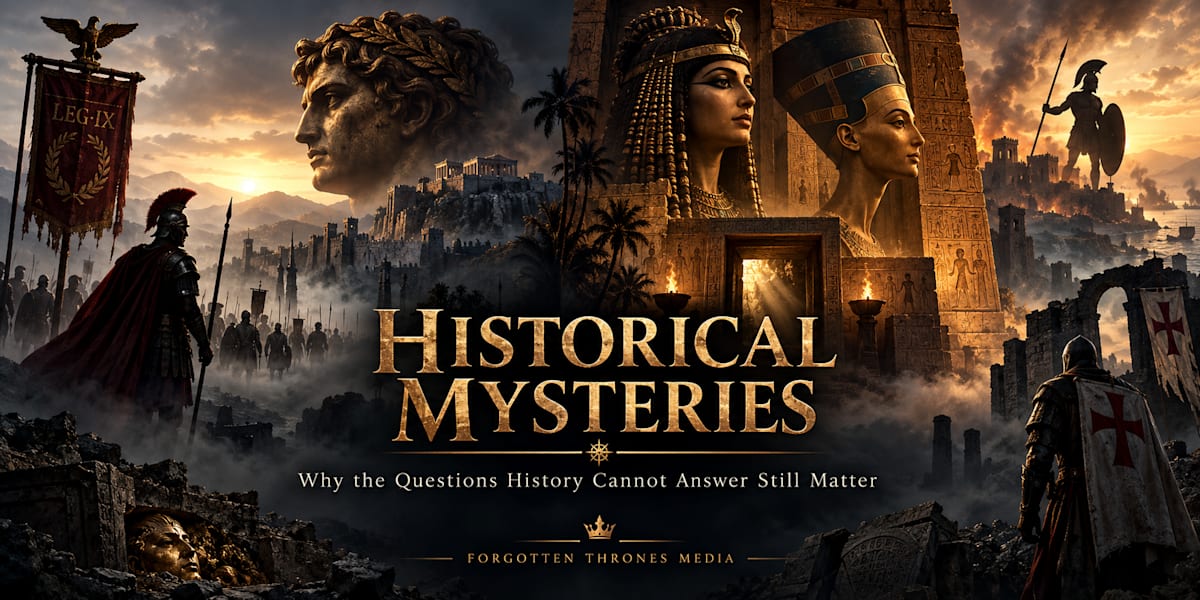
The disappearance of Rome’s Ninth Legion remains one of the best examples. For years, the popular story suggested that the legion vanished in Britain, possibly destroyed in battle. Later discoveries complicated that theory and raised the possibility that the unit may have survived longer than once believed. The mystery remains open because the evidence does not give us a final answer.
The same is true of Cleopatra’s tomb. Cleopatra VII is one of the most famous rulers in history, yet the location of her burial remains unknown. Ancient accounts tell us that she and Mark Antony were buried together, but no confirmed tomb has ever been found. That mystery continues to attract archaeologists, historians, and researchers because the answer may still be buried somewhere beneath Egypt.
Alexander the Great presents another type of mystery. We know where and when he died, but the exact cause of his death is still debated. His sudden illness in Babylon has produced theories ranging from disease to poisoning, and no single explanation has ever been proven beyond doubt.
Then there is Nefertiti, whose final years and burial place remain unresolved. Her image is one of the most recognizable from ancient Egypt, yet much of the end of her story is still missing. Questions surrounding possible hidden chambers near Tutankhamun’s tomb have only added to the fascination.
Where History and Legend Meet
Some mysteries become even more complicated when history blends with mythology. Achilles is a perfect example. Homer’s Iliad gives us one version of the warrior, while later traditions added details that eventually became part of the legend, including the famous story of the vulnerable heel.
The challenge is determining what belongs to the earliest surviving tradition, what appeared later, and whether any part of the story preserves memories of a real Bronze Age conflict.
That same question applies to many famous figures and events from the ancient world. How much is history? How much is legend? And how much has changed through centuries of retelling?
Why These Questions Matter
An unanswered historical question is not a failure. Sometimes it is simply the most accurate conclusion available.
The responsible approach to history is not to force an answer where the evidence does not support one. It is to separate what we know from what we suspect and to remain open to new discoveries.
That is becoming an important part of Forgotten Thrones Media. Whether through books, Forgotten Thrones TV, the podcast, or articles here on the website, the goal is not simply to repeat familiar stories. It is to examine the evidence, question assumptions, and explore what may still remain unresolved.
History has already given us extraordinary stories. The unanswered questions remind us that some of those stories may not be finished yet.
James P. Patterson
Founder, Forgotten Thrones Media LLC
Author • Digital Historian • Creator of Forgotten Thrones TV